

A major milestone for the UK built environment has arrived. On 10 March 2026, the UK Net Zero Carbon Buildings Standard (UK NZCBS) officially transitioned from its pilot phase to Version 1.
This marks the publication of the UK’s first cross-industry framework designed to robustly verify whether buildings are Net Zero Carbon Aligned. What began as a pilot launched in September 2024 has now evolved into a formalised methodology ready for adoption across the built environment.
Watkins Payne contributed to the development of the Standard through participation in the Pilot Testing Programme, helping to test and refine the framework alongside organisations across the industry.
The Standard provides the first unified methodology to demonstrate that buildings align with the UK’s legally binding carbon targets and the 1.5°C climate trajectory.
Unlike previous voluntary benchmarks, Version 1 emphasises measured in-use performance, rather than relying solely on design-stage predictions. It establishes a clear rulebook for how buildings should measure, report, and verify their carbon performance.
Key Principles:
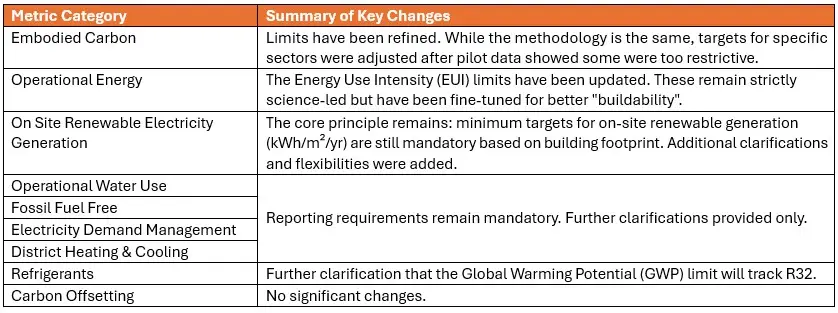
Version 1 introduces several refinements and new annexes based on industry feedback from the Pilot Testing Programme.
Version 1 introduces a new Annex for offices. You can now verify a "Landlord-only" or "Tenant-only" space if you can’t get data for the whole building.
A completely new optional verification at Practical Completion. It doesn't give you the "Net Zero" badge yet (you still need 12 months of data), but it officially confirms the project is "on the right path."
Version 1 now officially "recognises" NABERS UK and Passivhaus. If you meet their criteria, you don't have to repeat the same work for the NZCBS – it’s an "automatic pass" for those specific parts.
The embodied carbon limits (A0-A5 excl. seq) for a new office (whole building) include the following:
The embodied carbon limits (A0-A5 excl. seq) for a retrofit office (whole building) include the following:
The operational energy limits (kWh/m² GIA/yr) for a new office include the following:
The operational energy limits (kWh/m² GIA/yr) for an existing office with one-go retrofit include the following:
The operational energy limits (kWh/m² GIA/yr) for an existing office with stepped retrofit include the following:
The Standard is expected to evolve further over time. While certain elements are not included in the current version due to a lack of sufficiently robust data, future updates are intended to incorporate the following:
It is also anticipated that operational energy limits will be refined to reflect factors such as occupancy density and intensity of use. In addition, the Standard will continue to adapt in response to emerging guidance and data from external organisations, including the Climate Change Committee (CCC) and the National Energy System Operator (NESO).
As future iterations are aligned with the most up-to-date carbon and energy budgets, associated limits and targets may be revised to support the UK’s decarbonisation pathway and carbon reduction commitments. However, any such revisions will not affect buildings that have already achieved verification. These planned enhancements demonstrate the Standard’s commitment to keeping pace with the latest science, policy, and industry best practice.